Formula E Is Not What You Think
Clean Speed Has Come a Long Way

I’ve been driving an EV for years now, but I haven’t had much luck converting even my most climate-conscious friends.
I find myself repeating the same arguments: EVs are quieter, faster off the mark, cheaper to maintain, and if I’m honest, just more fun to drive. You’d also be in the company of people trying to make the future better.
Unfortunately, old habits, perceived limitations, and a lingering sense that EVs are some kind of compromise still get in the way. It’s the same resistance, incidentally, that I run into when I try to get people to taste the Impossible Burger.
But I now realize that there is a much greater embodiment of this idea than anything I could say: the all-electric global racing series, or Formula E.
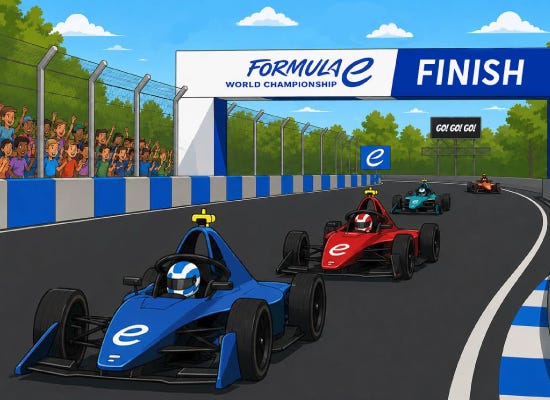
A Different Kind of Racing
I was a latecomer to Formula E. When it launched in 2014, it felt like a clever marketing gimmick more than a serious development in motorsport or the energy transition. Quiet cars, short races, and early technical constraints made it easy to underestimate.
A decade later, that skepticism no longer holds up. Formula E has evolved into a high-performance proving ground for electric mobility, backed by major automakers and increasingly relevant to the real-world transition away from internal combustion engines.
Here are a few dimensions that make Formula E so exciting:
The cars themselves are remarkably advanced. Today’s machines can top 200 mph, but raw speed is only part of the story. What really defines Formula E is energy management: drivers aren’t just racing each other, they’re racing their own battery constraints.
Regenerative braking plays a central role. A substantial portion of the energy used in a race is recaptured during braking and fed back into the battery. In some cases, roughly 40% of total race energy comes from regeneration. That’s extraordinary efficiency—and a preview of where consumer EV technology is heading.
There are unique strategic elements in Formula E that have no real analogue in traditional racing. Attack Mode, for example, gives drivers a temporary power boost if they deviate from the optimal racing line to activate it. It’s a small but telling feature: even in a fully electrified system, performance is shaped by smart choices, timing, and decision-making.
There’s also the quiet but important story of the battery itself. Early seasons required mid-race car swaps because the technology simply couldn’t go the distance. Today’s cars complete the race in one piece, and this season the series even reintroduced brief mid-race charging stops—not because the battery can’t last, but because a 30-second top-up unlocks extra power, turning faster charging into its own strategic weapon. The pace of improvement is hard to miss.
And there’s the venue. Formula E races are typically held on temporary street circuits in major cities such as New York, London, and Rome—bringing the sport directly into urban environments where electrification matters most.
Lessons Beyond the Track
What I initially overlooked (and now seems obvious) is that Formula E is not really about racing. It is about accelerating a technology curve. It shows what happens when you take a critical clean-energy technology, subject it to extreme performance demands, and give world-class engineers a reason to improve it quickly.
That dynamic should sound familiar. We’ve seen it in semiconductors, in solar panels, and in batteries. Formula E is doing something similar for electric drivetrains, power electronics, and energy management systems. And because major automakers are directly involved, the feedback loop into commercial vehicles is immediate.
There are a few broader takeaways here that strike me as directly relevant to the clean economy.
Constraints can be a feature, not a bug. In Formula E, strict energy limits force innovation. Efficiency becomes a competitive advantage. The same principle applies across the energy transition, where carbon constraints are increasingly driving better system design.
Performance matters more than virtue. People may not adopt new technologies at scale simply because they are cleaner. But they will adopt them when they are better. Faster acceleration, lower operating costs, smarter energy use—these are the attributes that should win in the marketplace.
Visibility accelerates acceptance. By racing in city centers, Formula E makes electrification tangible. It turns an abstract transition into something people can experience directly. That should help build public momentum.
The clean energy transition is not a story of compromise. It is a story of reinvention. The best electric technologies are not substitutes for what came before—they are sharp improvements.
If there is a single lesson I take from Formula E, it is this: the path to decarbonization runs through better products, not just better policies.
So often the shift away from internal combustion engines is framed as a trade-off—performance versus sustainability, cost versus responsibility. Formula E undermines that narrative. It shows that, under the right conditions, clean technologies can redefine performance itself.
That’s not just good news for racing. It may also be exactly the kind of proof point needed to convince the still-skeptical driver that the future has already arrived.
So if you’ve been on the sidelines of the EV revolution, do me a favor. First, check out a Formula E race. The Shanghai E-Prix is coming up over the fourth of July and there are plenty more races after that. Then go visit your local EV dealer and take one out for a test drive. I bet you’ll be surprised. And while you’re at it, treat yourself to an Impossible Burger too. They taste great and might just save us.
Onward,

Hi Mark, I too have been driving an EV since 2013 and absolutely love it...and I'm not really a car guy. Always prefer a bicycle. :) Anyhow regarding our narrative, here's one I often share when discussing EVs on social media with the cynics (haters). I point out "I'm not sure why you're so negative on EVs...the more (other) people buy them the less demand for gas...less demand equals lower prices for gas...everybody wins." If that convinces them to reduce their vitriol...even if they don't choose an EV, I think that's a win. Cheers.