Blame Canada?
Smoke, Fire, and Who Actually Owns This Problem

The haze that’s been sitting over half the country this week isn’t an accident, and it isn’t Canada’s fault for neglecting yard work.
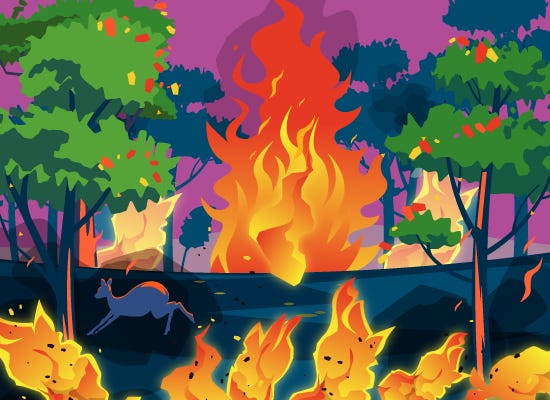
Nearly 900 wildfires are burning across Canada right now and have already scorched roughly 11,000 square miles—an area slightly bigger than Massachusetts. The smoke has pushed air quality into “unhealthy” or “hazardous” territory across more than 20 U.S. states, from the Midwest to Washington, D.C., putting something like 100+ million Americans under air quality alerts.
With such an extreme weather event, there are a few things worth being clear-eyed about:
The people hit first and hardest are Indigenous communities living in and near these forests. Since April, dozens of First Nations have been directly impacted, with thousands of residents evacuated at some point this season and well over a thousand still displaced as of mid-July. These people have lost homes, and they’ve been exposed to very dangerous smoke.
The smoke is a serious health threat. A study published this year found that long-term wildfire smoke exposure contributes to roughly 24,100 deaths a year in the lower 48 states alone. The smoke’s particulate matter drives heart disease, asthma, premature birth, and— over time—cognitive decline.
The actual cause is a record heat wave, not “debris.” Ontario just came off a heat wave that shattered longstanding records: Armstrong hit an all-time high of 40.7°C, and Toronto came close to its own July 14 record. The heat dried out forests and allowed lightning strikes to ignite the fire. Climate scientist Daniel Swain lays all of this out clearly if you want to understand the deeper mechanics. He’s worth following.
The White House response has been to blame Canada’s “willful negligence” and threaten new tariffs, arguing that Canada “refused to engage in basic Forest Management and Debris Removal.” Trump made the same claim against California in 2018 and 2020…and fire scientists debunked it then too. Forest management affects fire behavior at the margins, but it doesn’t create the heat domes and record dryness now allowing fires to ignite across nine provinces and all three territories.
The premise doesn’t hold up anyway. Canada’s boreal forest spans roughly 1.2 billion acres. It’s the largest intact forest ecosystem left on Earth. Most of the forest is remote wilderness with no roads and no history of active management. Fire is how that ecosystem has always renewed itself. Blaming “debris removal” for fires burning across an area that size is like suggesting a few sandbags would have prevented Hurricane Katrina.
And if we’re assigning blame by contribution, we’d start by acknowledging that the US has emitted more cumulative CO2 than any other country in history—roughly two-thirds more than China, the next-largest emitter, and about a fifth of the global total. If anyone owes anyone an accounting here, the math doesn’t point north.
We’ll have a more comprehensive take on White House lying coming soon. But in the meantime, dear readers, here’s our ask of you. When you come across arguments along these lines—Canada is negligent, its forests are unraked—please push back and state that this view is nonsense. Don’t duck. Say clearly that this is a climate story, not a landscaping story.
And remember this as you consider the midterm elections. Please support and vote for candidates who don’t deflect and mislead about serious events like this one, but are instead guided by science and propose sensible, realistic ways to address challenges like climate change.
Onward,